Categories
Biography Comedy Film Hollywood Silent Film Theatre

James Finlayson honoured at the Dobbie Hall

Earlier this year James Finlayson was finally honoured in his home town of Larbert, where a painting of him by local artist Connor Draycott was unveiled on 9th March at the Dobbie Hall.

The event was naturally covered by local newspaper The Falkirk Herald, but was also picked up by BBC News and even in the Metro, which has the largest national newspaper print circulation in the UK.

A Small Town Idol

The afternoon of Fin fun was MC’d by Gary Bouse of the Dobbie Hall Trust, the charity which commissioned the portrait. There was a screening of the Laurel & Hardy film BONNIE SCOTLAND (1935), a talk about James’ early life and career, and video installations by pupils of Larbert High School.

Programme for the Remembering James Finlayson event at the Dobbie Hall

Following a speech by Ian Gardner of the Dobbie Hall Trust, the portrait of James was unveiled by two of his first cousins once removed: Ralph Palmer and John Adam.  Ralph is the grandson of James’ paternal aunt Christina Palmer née Finlayson and John is the grandson of James’ maternal aunt Jane Calder Adam née Henderson.

The portrait of James Finlayson being unveiled.
The portrait of James Finlayson being unveiled. Left to right: Ralph Palmer, Connor Draycott, John Adam, Gary Bouse (on stage), Ian Gardner.

James’ portrait now stands in the entrance foyer of the Dobbie Hall alongside the Scottish Film Council plaque awarded to him in 1996 (now relocated from Bo’ness Library).
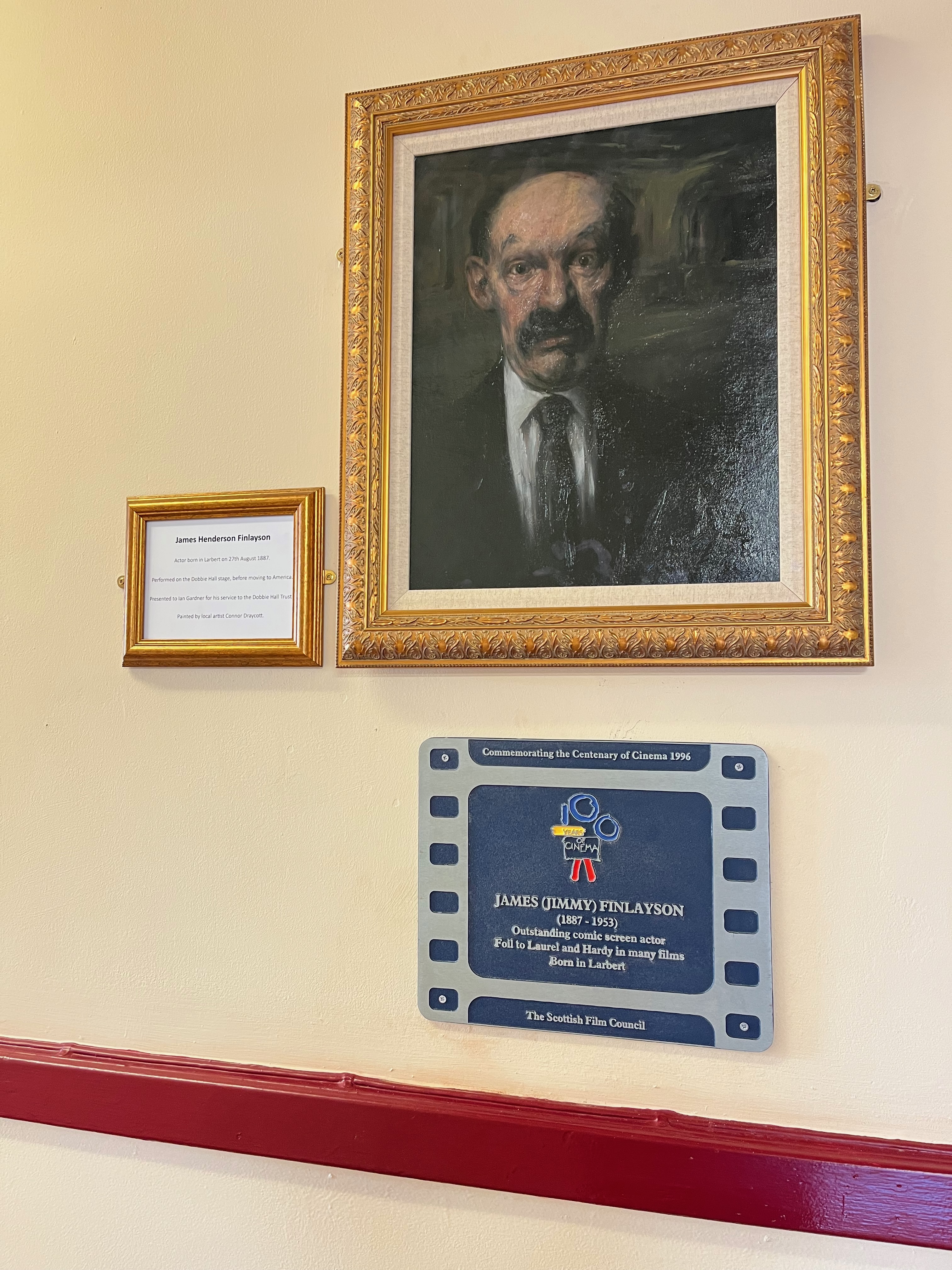
The portrait of James Finlayson hanging in the Dobbie Hall alongside his 1996 Scottish Film Council plaque

Our Relations

James Finlayson had two brothers and three sisters who also emigrated to the United States, and the descendants of his sisters Jean and Euphemia were delighted by news of the event.

Jean’s grandson, Steven Rice from Virginia, said: “When I saw the portrait of James Finlayson I was hit with overwhelming pride. Ever since I found out that James was dad’s uncle I always looked for movies that he was in, and it amazes me to find out that movie lovers still remember him for his comic acting style.

Brother Craig Rice added: “The portrait was nice, I’m glad he is being recognized.

And Sister Heather Dennis said: “The portrait is fantastic. I was very young when he died but we would watch him in the Laurel and Hardy movies and tell my Dad there is Uncle Jim.

Euphemia’s granddaughter, Jeanne Hanson from Tennessee, said: “I absolutely love the portrait of my Uncle Jim. If a whimsical and a serious demeanor could be combined, the artist most definitely captured it.

I would like to thank the people of Larbert for honouring a native son for his many accomplishments in the early era of cinema. The comedies of today could learn so much from the silent movies. Not a word was spoken but the side splitting laughter is a nod to their great acting skills. James Henderson Finlayson was one of those beloved pioneers.

Jeanne Hanson, Grand Sheik, Our Relations Tent of James Finlayson

Home Talent

The Dobbie Hall was where James started out in amateur dramatics whilst working as a tinsmith, being praised for his roles in the plays Rob Roy, Current Cash and The Shaughraun between 1907-09:

The acting of Mr J. H. Finlayson, as the “Dougal Cratur,” could not possibly have been improved upon. He was the life and soul of the piece, and his representation of the faithful and cunning follower of the Gregarach was warmly and deservedly applauded.

STENHOUSEMUIR AMATEUR DRAMATIC ASSOCIATION – PRODUCTION OF “ROB ROY”, Falkirk Herald, 13 Feb 1907.

A very large share of the work and responsibility as to the success of the piece rested with “Private Ned Bootles” (Mr James Finlayson) and “Rev. Lincoln Green” (Mr G. Anderson), and right well did they sustain their parts. Mr Anderson, as the quiet, simple vicar, was particularly effective, while the part of “Bootles” could not have been in more capable hands than those of Mr Finlayson.

“CURRENT CASH” – SUCCESSFUL PERFORMANCE BY STENHOUSEMUIR AMATEUR DRAMATIC ASSOCIATION, Falkirk Herald, 25 Dec 1907.

Mr James Finlayson, who has scored previous successes, added considerably to his laurels as “Captain Molineux”.

LARBERT AND STENHOUSEMUIR DRAMATIC CLUB – PRODUCTION OF “THE SHAUGHRAUN”, Falkirk Herald, 10 Mar 1909.

However, James was not the only Finlayson to appear at The Dobbie Hall. His cousin Marion Finlayson was a local dance teacher and regularly held social dances and children’s fancy dress dances at the Dobbie Hall, sometimes assisted by her sister Helen and brother John.

Completing the family connection, James’ uncles Robert and Malcolm Finlayson worked as grate fitters for Dobbie, Forbes & Co., the company founded by Major Robert Dobbie, the benefactor of the eponymous hall.

Sold at Auction!

The Dobbie Hall Trust are still looking for seat sponsors for the refurbished balcony. For a small cost, fans of James Finlayson have the opportunity to have their own personalised engraving on a rose gold plaque adorning one of the new seats in the very venue where James started off his acting career all those years ago.

Flyer from Dobbie Hall Trust re balcony chair sponsorship. The cost is £50 per chair, valid for 10 years. For more info email dhtevents@dobbiehall.org.uk
Flyer from Dobbie Hall Trust re balcony chair sponsorship
Categories
Biography Comedy Film Hollywood Silent Film

Doing the Larbert Walk

It is a rather wet Friday afternoon in Stenhousemuir in July 1924.  At the back of the Picture Palace cinema, a small clean-shaven bespectacled man puffs on a cigarette.  Although only in his mid-thirties, he is balding and looks much older.  He is somewhat tanned and dressed immaculately in what some would describe as “the American way” down to his tortoise-shell shoes.  A sign at the front of the building reads “TODAY: ‘A Day in the Life of a Cinema Artiste’, an illustrated lecture by James Finlayson”.

Whilst the talk had covered his days at Mack Sennett with his friend Ben Turpin and then being hired by Hal Roach to work opposite Stan Laurel, most of the presentation had been spent viewing the several thousand feet of film James had brought with him from Hollywood.  This had featured scenes from some of his latest films including ‘Rupert of Hee-Haw’, a lampoon of the sequel to ‘The Prisoner of Zenda’.  The audience having long since filed out, James decides to go for a short walk back to his old family home.  After first having been tempted to cross the street to the Plough Hotel for a small libation, he makes his way out west along Main Street.

Within a couple of minutes he passes the Dobbie Hall and, making a dramatic pause, recalls his first tentative appearances on the stage inside with the Stenhousemuir Amateur Dramatic and Musical Association.  He also remembers the large parade in 1900 celebrating the laying of the foundation stone with full Masonic honours.  Some two thousand marchers, led by the Carters on horseback and including representatives of the Foresters, Rechabites, Free Gardeners, Shepherds and Ironmoulders as well as the Boys’ Brigade, stretched for nearly a mile all the way from Pretoria Road to Larbert Railway Station.

James continues on his stroll along Main Street, past the station and Foundry Loan which leads to the ironworks.  Twenty-three years ago, James had been a young tinsmith at the Torwood Foundry.  He smiles as he thinks how fitting that he appeared in a film called ‘The Village Smithy’.  Suddenly, he hears heavy footsteps behind him, then turns around and does a double-take – it’s a large, fat man wearing a bowler hat.  D’ooooooh!  

After passing the Village School where he learned to read and write, he turns right down Victoria Road, mimicking the parade route.  There he stands outside his parents’ old home.  He thinks of how much he loved them and weeps.  The tears of a clown are shed as he recollects the painful shocks of the sudden losses of first his mother, then his older sister, and finally his father.  He hopes that they would have been proud of his cinematic achievements and reflects that he has done not too bad for a wee orphan boy from Larbert.


Route from the Plough Hotel, Stenhousemuir to Victoria Road, Larbert
Source: Google Maps

The short story above was submitted as an entry to the ‘500 Words for Falkirk’ short stories competition held by Great Place Falkirk in 2021. It depicts an imagined stroll by James Finlayson from a cinema in Stenhousemuir to his family’s house in Larbert and was inspired by a couple of newspaper articles: the first described the parade marking the start of construction on the Dobbie Hall in June 1900,1 and the second James’ film lecture at the Stenhousemuir Picture Palace in July 1924:

Local picture-goers had the opportunity on Friday last of acquiring first-hand knowledge about the famous film centre – Hollywood. Mr Jim Finlayson, of whom reference has already been made in this corner, appeared in person at Mr Faulkner’s establishment and gave a sort of illustrated lecture.

Mr Finlayson brought with him from Los Angeles several thousand feet of film depicting a day in the life of a cinema artiste, with himself as the character study in this instance. His remarks, together with the picture, were interesting to a degree.

Source: ’JOTTINGS OF THE WEEK – LARBERT AND STENHOUSEMUIR’, Falkirk Herald, 19 July 1924, p. 4.
Detail from Ordnance Survey map Stirlingshire nXXIV.14 (Revised: 1943, Published: 1947) showing the Picture Palace cinema and the Plough Hotel in Stenhousemuir with the Dobbie Hall to the west
Reproduced with the permission of the National Library of Scotland

James had sailed from New York to Glasgow on the S.S. Tuscania, travelling First Class and arriving in Scotland on 9 Jun 1924.2 The ship’s manifest gives his occupation as Actor & Film Director, which opens up speculation that perhaps he had shot a behind-the-scenes Hollywood documentary? He arrived in his native Larbert on the same day, impressing the local youth with his stateside garb:

After chronicling from time to time items of interest regarding Jim Finlayson, the film star, who, amongst other distinctions, can say he is a Larbert chiel, this week we are able to report his arrival in the “dear auld hame”.

Mr Finlayson got here on Monday, to the delight of the younger generation, who seemed greatly taken on with his decided American appearance. With his “tortoiseshells”, the lad o’ pairts does not seem to have altered much during his thirteen years’ absence.

To a friend, Mr Finlayson confided that he saw no difference in the townlet, except that it was wetter than it used to be. Just to show that he hasn’t lost his skill in the tinsmithing line, Jim visited Torwood Foundry on Tuesday and produced a dustpan.

Source: ’JOTTINGS OF THE WEEK – LARBERT AND STENHOUSEMUIR’, Falkirk Herald, 14 Jun 1924, p. 6.
Detail from Ordnance Survey map Stirlingshire nXXIV.13 (Revised: 1943, Published: 1947) showing Larbert Village School and Victoria Road in Larbert with the Torwood Foundry to the north
Reproduced with the permission of the National Library of Scotland

After his visit to Larbert, he went to London and then on to Europe:

Jim Finlayson, the “film punster” (as he was designated by a Los Angeles contemporary) is not going back to the States without seeing a big slice of Europe.

Mr Finlayson left for the South on Sunday night, and after a brief stay in London he means to visit most of the Continental capitals, not by common or garden rail transport, if you please, but by the more up-to-date air service.

Source: ’JOTTINGS OF THE WEEK – LARBERT AND STENHOUSEMUIR’, Falkirk Herald, 5 July 1924, p. 4.
The Dobbie Hall around the time of James’ visit
Photo: Falkirk Herald Photographic Collection, Falkirk Council Archives

He returned to New York from Le Havre, France aboard the S.S. Paris on 16 Aug 1924.3 He had been staying at the Hotel Rochambeau in Paris. His subsequent return to work being reported in the movie press:

Jim Finlayson, Roach comedian, has returned to New York en route to the Coast from Scotland to begin work on Labor Day.

Source: ’Finlayson Returns’, The Film Daily, 27 Aug 1924, p. 1.
S.S. Paris
Photo: Freshwater and Marine Image Bank, University of Washington

He would return again to Scotland the following year,4 when he stayed at the Plough Hotel mentioned in the short story above.

The Plough Hotel around the time of James’ stay
Photo: Kemp Postcard Collection, Falkirk Council Archives

Finlayson would repeat these transatlantic crossings a number of times in his lifetime, with at least four voyages on the S.S. Paris. If only they had sail miles in those days instead of air miles – d’oh!

With apologies to Lupino Lane for the title of the short story.

Sources

  1. ‘MAJOR DOBBIE’S GIFT TO LARBERT & STENHOUSEMUIR’, Falkirk Herald, 27 June 1900, pp. 4-5.
  2. 1924 Incoming Passenger Lists for the port of Glasgow, Ancestry.co.uk, The National Archives of the UK; Kew, Surrey, England; Board of Trade: Commercial and Statistical Department and successors: Inwards Passenger Lists.; Class: BT26; Piece: 755.
  3. “New York Passenger Arrival Lists (Ellis Island), 1892-1924”, database with images, FamilySearch (https://familysearch.org/ark:/61903/1:1:JNH4-QMW : 30 January 2018), James Finlayson, 1924.
  4. 1925 Incoming Passenger Lists for the port of Liverpool, Ancestry.co.uk, The National Archives of the UK; Kew, Surrey, England; Board of Trade: Commercial and Statistical Department and successors: Inwards Passenger Lists.; Class: BT26; Piece: 792; Item: 6.
Categories
Biography Broadway Comedy Film Hollywood Silent Film Theatre

A Clean-up on the Curb

James Finlayson played the part of a street cleaner in this Rosco Ates RKO comedy two-reeler, which was directed by Lloyd French and released on 12 Sep 1931.1

The film’s title gave me the idea of clearing up some of the rubbish that has been written about James Finlayson over the years. After thorough research, I can tell you that every biographical article I’ve read contains untrue statements that are, well, garbage. It’s been very disappointing that few writers seem to bother with source citations and this has led to unfounded speculation on aspects such as his family background, education and the beginnings of his acting career. Typically, the absence of research results in lazy pigeon-holing that he must have followed the journey of other British comedians (e.g. Chaplin, Laurel) by playing in music halls before coming over to America in a performing troupe. Much has been copied unchallenged from his 1953 obituaries (no doubt thrown together quickly) and in turn copied from other biographies and embellished to fill in the blanks. The biography I am writing is, however, built from the bottom-up by examining contemporary primary sources such as genealogical records (e.g. census returns, passenger lists, etc.) and newspaper archives. I won’t be copying and pasting anyone else’s work.

So, let’s look at a few of the more common claims made about James’ life and career and play a game of Truth or Trash, or more appropriately Yes or D’oh!

James Finlayson was born in Falkirk

D’oh! To the shame of the British Film Institute, their filmography of James has his place of birth as Falkirk.2 Other biographies say “Larbert, Falkirk”. A 1997 article in The Stage even claimed that James was from my hometown of Grangemouth.3 While his maternal grandparents (my great-great-grandparents) James and Isabella HENDERSON did eventually move to Grangemouth, and he had a number of aunts and uncles there (including my great-grandparents), he most certainly wasn’t born there. James was in fact born in the village of Larbert in the parish of Larbert in the county of Stirling (or Stirlingshire).4 Larbert only became part of Falkirk District Council in the 1975 local government reorganisation in Scotland, so “Larbert, Falkirk” is not correct. “Larbert, near Falkirk” would be acceptable given their geographical proximity.

1897 map of Stirlingshire showing Larbert, Falkirk and Grangemouth.
Reproduced with the permission of the National Library of Scotland.

James Finlayson came to America in the cast of ‘Bunty Pulls The Strings’

D’oh! James’ obituary in the LA Times claimed that “in 1912 he came to America as a juvenile player in a Scottish comedy that played Broadway for 13 months – ‘Bunty Pulls the Strings'”. However, James was not a cast member of the London production of Graham Moffat’s comedy at the Haymarket Theatre in August 1911,5,6 nor was he an original cast member of the Broadway production in October 1911.7,8 James’ part of Rab Biggar was played by George Tawde in London,6 and initially by Edmond Beresford in New York.7,8 In fact, James came to America for family reasons, arriving in New York with his younger brother Robert in June 1911.9 He was a 24 year old actor, so hardly “a juvenile player”. James joined the cast of ‘Bunty’ in May 1912,10,11 as well as appearing in a couple of other New York theatre offerings.12

Lewis Waller will present “The Great Game”, a one-act play by W. Cronin Wilson, as a curtain raiser to “The Explorer” at Daly’s Theatre, beginning on Thursday evening. The piece has never been produced in this country, but was used by Mr. Waller as a curtain raiser to several of his London productions, and it has also been given in the English music halls. The three characters will be played at Daly’s by Frank Woolfe and Lewis Broughton of “The Explorer” company and James Finlayson, who is appearing in the second act of “Bunty Pulls the Strings”.

‘Waller to Give a One-Act Play’, The New York Times, 14 May 1912, p. 11.

James Finlayson toured America with Alec Lauder in ‘The Concealed Bed’

D’oh! The origin of this particular nonsense nugget appears to be a letter written by Stan Laurel in 1964 to researcher Hank Jones,13 who subsequently wrote an article for the first ‘Pratfall’ magazine of the Way Out West tent.14 Stan was in the last year of his life, and perhaps his memory was not as good as it had been. In any event, he has confused James with his fellow Scotsman and good friend Andy Clyde, who did tour in the Graham Moffat sketch ‘The Concealed Bed’ along with Helen MacDonald, Janet Gardner, Bessie MacDonald and Stuart Black.15,16,17 The Alec Lauder reference is perhaps to the play ‘The Night Before’ – written by Harry Lauder – that James produced and appeared in alongside Andy Clyde in 1916.18,19

Sansone [sic] and Delila, a pair of sensational gymnasts, started the ball rolling. They were followed by the Earl and Curtis Company, who paved the way nicely for the Grahame [sic] Moffat Players in The Concealed Bed. Here is an act that will never fail to please any kind of an audience. It is written in Mr. Moffat’s best vein and is acted by an exceptionally competent Scottish company. The work of Andrew Clyde as Bob Dewar, and the impersonation of a scandal mongerish, trouble-making character by Miss Bessie McDonald, are particularly worthy of notice in a cast of five people that, for general excellence, has never been beaten, at least in vaudeville.

‘Keith’s Union Square’, The Billboard, 2 Nov 1912, p. 10.

James Finlayson was a Keystone Cop

Yes! Of course, James wasn’t an original Keystone Cop (as stated in almost every obituary) as he was still in theatre in 1912-17,12 but he played one in both the Masquers’ comedy STOUT HEARTS AND WILLING HANDS (1931),20,21 and Darryl F. Zanuck’s HOLLYWOOD CAVALCADE (1939).22,23,24 James also made a number of public appearances dressed as a Keystone Cop, including at Mack Sennett’s testimonial dinner held by the Masquers in 1948,25 and at the Shriners parade held in the Los Angeles Coliseum in 1950 where he, Tiny Ward, Snub Pollard, Chester Conklin, Heinie Conklin and Hank Mann careered around the track in a old Model T, to a rousing ovation from the 90,000 crowd.26

Roscoe Arbuckle, Bobby Vernon, Ford Sterling, Chester Conklin, Clyde Cook, Mack Swain, James Finlayson and (reclining) Hank Mann.
Picture: The New Movie Magazine, Aug 1931, vol. 4, no. 2, p. 70.
Sources
  1. Radio to Offer 56 Short Films‘, Motion Picture Herald, 16 May 1931, p. 68.
  2. James Finlayson‘, British Film Institute.
  3. Irving, Gordon. ‘Master of the double-take’, The Stage, 7 Aug 1997, p. 8.
  4. 1887 Birth of James Henderson FINLAYSON in Larbert, ScotlandsPeople (Statutory Births 485/00 0151).
  5. ‘THE SCOTTISH ‘SIXTIES: A GREAT SUCCESS AT THE HAYMARKET’, The Sketch, 9 Aug 1911, p. 132.
  6. ‘SEVEN MOFFATS IN A PLAY BY MOFFAT’, The Sketch, 9 Aug 1911, p. 133.
  7. ‘EVENING OF RARE JOY WITH SCOTCH PLAYERS’, The New York Times, 11 Oct 1911, p. 11.
  8. ‘SCOTCH ACTORS SUPPLY TREAT OF A LIFETIME’, The Brooklyn Daily Eagle, 11 Oct 1911, p. 5.
  9. Ship’s Manifest of the S.S. California arriving in New York from Glasgow on 5 Jun 1911, FamilySearch.
  10. ‘”THE GREAT GAME”‘, The Brooklyn Daily Eagle, 14 May 1912, p. 15.
  11. ‘SCOTCH COMEDY PLEASES’, Long Branch Daily Record, 29 Aug 1912, p. 6.
  12. Theatre career of James Finlayson‘, Larbert Loon.
  13. Letter from Stan Laurel to Hank Jones, 26 Sep 1964, The Stan Laurel Correspondence Archive Project.
  14. Jones, Hank. ‘Here’s to Fin!‘, Pratfall, 1969.
  15. ‘With Folk of the Stage’, San Francisco Chronicle, 24 Mar 1912, p. 23.
  16. ‘Keith’s Union Square’, The Billboard, 2 Nov 1912, p. 10.
  17. Ship’s Manifest of the S.S. Columbia arriving in New York from Glasgow on 12 Mar 1912, FamilySearch.
  18. ‘”THE NIGHT BEFORE” AT THE COPLEY’, The Boston Sunday Globe, 9 Jan 1916, p. 10.
  19. ‘THEATER NOTES’, Syracuse Journal, 6 Mar 1916, p. 14.
  20. The Keystone Cops Return‘, American Cinematographer, May 1931, pp. 16-17.
  21. BACK on the BEAT AGAIN‘, The New Movie Magazine, Aug 1931, vol. 4, no. 2, p. 70.
  22. ‘Keystone’s Finest’, The San Francisco Examiner, 27 Aug 1939, p. 25.
  23. HOLLYWOOD CAVALCADE‘, The Movies … and the People Who Make Them, vol. 1, no. 52, p. 132.
  24. Hollywood Cavalcade‘, Motion Picture Herald, vol. 137, no. 1, 7 Oct 1939, p. 35.
  25. Masquers Fete Sennett; Friars Honor Wynns‘, Variety, 25 Aug 1948, p. 2.
  26. Chill, Smoke, Miscues Fail to Mar 79th Annual Shrine Fez-tivities‘, Variety, 28 Jun 1950, pp. 2,61.